
Patent Portfolio
A growing patent portfolio covering key H-PHY circuit, signaling, and system concepts.
Core Technology Protection
Patent activities covering key H-PHY technologies and architectural concepts.
Global IP Development
Patent activities across Korea, the United States, China, and international filing routes.
Layered Technology Portfolio
Intellectual property spanning circuit, signaling, architecture, and system-level concepts.
IP-Aware Technology Development
Technology development informed by ongoing review of relevant prior art and patent landscapes.
Evolving Patent Families
Patent families developed alongside the continuing evolution of H-PHY technologies.
Supporting Future Collaboration
An IP foundation supporting future technical collaboration and continued development.
Patent Filings by Region
Core H-PHY technologies are filed and prosecuted across Korea, the United States, China, and the PCT route.
Innovation Timeline
A decade of layered R&D — each stage adds a new class of protected technology to the platform.
Foundation (CCII Core)
Single-Wire Communication
Data Communication
High-Speed PHY & System
Symbol Encoding, Clock Recovery
IP-Aware Technology Development
H-PHY development includes ongoing review of relevant prior art and patent landscapes to inform architectural and circuit-level design decisions.
H-PHY™ Technology Architecture
Current-domain signaling, RX-centric receiver architecture, and DC-balanced PAM signaling.
Architecture-Driven Innovation
A PHY architecture developed through circuit-level research and short-reach interconnect optimization.
Current-Domain Signaling
Current-domain signaling supporting ultra-low swing, energy efficiency, and scalable connectivity.
Ultra-Low Energy
Minimized CV2 switching energy enabling low energy per bit.
Robust Signal Integrity
Designed to reduce sensitivity to SSN, PDN disturbance, and crosstalk in high-density interconnects.
Technology-Scalable Architecture
Designed to scale with advanced process nodes, higher I/O density, and Wide I/O architectures.
Flexible System Integration
Designed for integration with SoCs, HBM interfaces, chiplets, and advanced packaging systems.
H-PHY™ Brand Identity
The H-PHY™ trademark establishes a consistent technology identity and reflects a long-term commitment to next-generation semiconductor interconnect research.
Brand Identity
Establishing a consistent identity for the H-PHY technology platform.
Trademark Foundation
Trademark protection being developed across key markets.
Global Identity
Building a consistent technology identity across global research and industry communities.
Technology Credibility
Representing continuity, technical focus, and long-term commitment.
Technology Identity
A recognizable identity supporting the continued development of H-PHY technologies.
Long-Term Foundation
Supporting a stable foundation for continued research and technology development.
Dedicated H-PHY™ Web Platforms
Dedicated H-PHY web domains have been secured to support technical communication, research visibility, and global accessibility.
Continuous Technology Development
H-PHY continues to evolve through circuit research, simulation, silicon validation, and architectural development for future high-bandwidth interconnects.
Explore New Architectures
Explore new circuit and signaling approaches for next-generation interconnects.
Refine Through Engineering
Continuously refine circuit performance, energy efficiency, and signal integrity.
Scale Across Technologies
Evaluate H-PHY architectures across process nodes, interconnect structures, and system requirements.
Research & Technical Collaboration
Engage with research and industry communities to evaluate emerging interconnect challenges.
Advance System Efficiency
Develop technologies addressing bandwidth, energy, and integration challenges.
Continue Technology Evolution
Extend H-PHY concepts toward future memory, chiplet, and advanced packaging systems.
Advancing Short-Reach PHY Technology
Our focus is to establish a scalable technology foundation addressing the evolving energy, bandwidth, and integration requirements of AI, memory, and advanced packaging systems.
Anticipate Future Requirements
We anticipate future needs and identify what's next.
Define Technology Directions
A clear vision guides our innovations and long-term strategy.
Engineering-Driven Insight
Deep understanding of technology and markets drives meaningful solutions.
Develop Future Interconnects
We envision and build technologies that create lasting impact.
Innovation with Technical Purpose
Our vision inspires continuous innovation for a smarter, more efficient world.
Advance Connectivity Technology
Our technology vision empowers the next generation of connectivity.
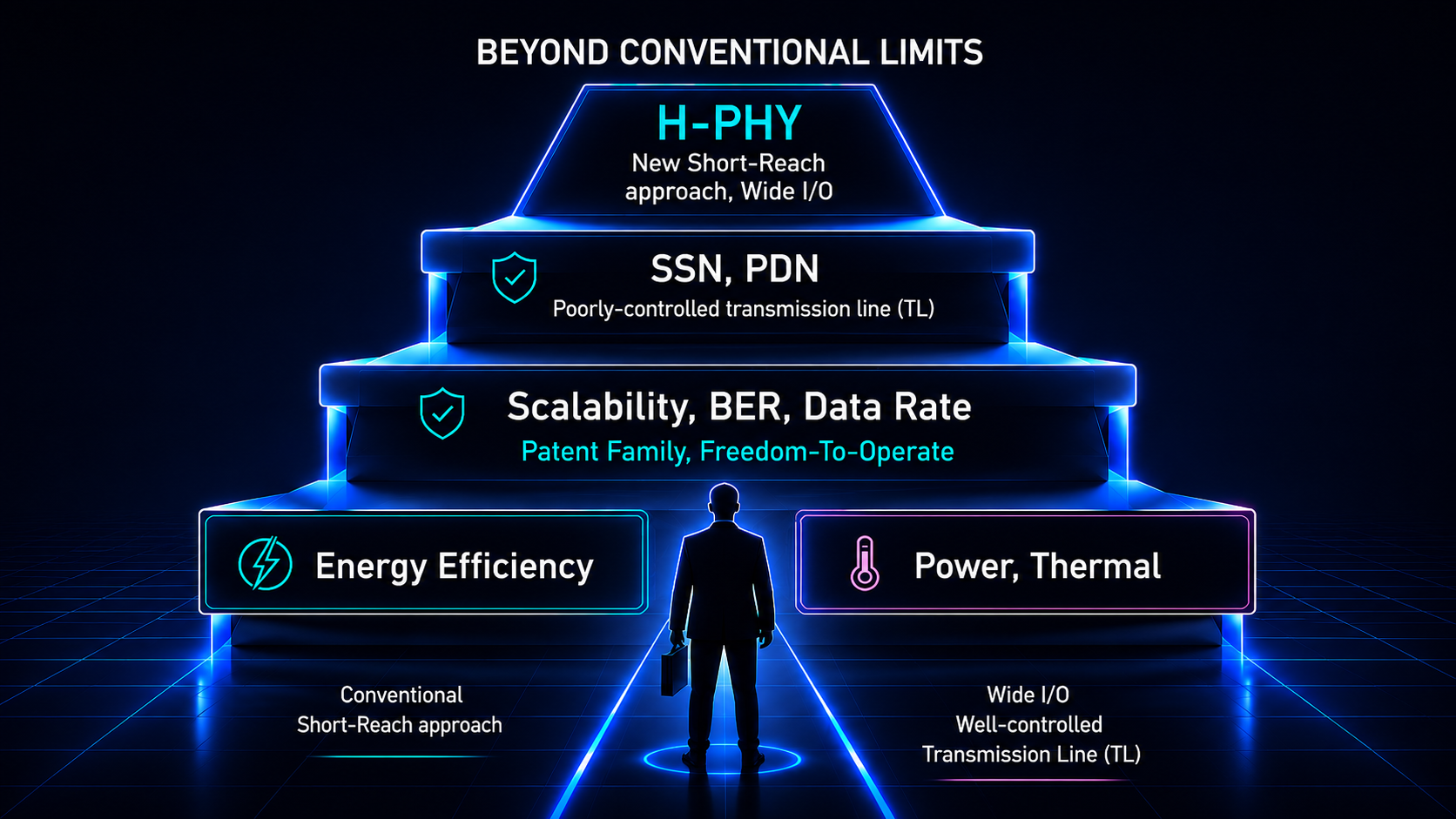
Beyond the Conventional Limits